Posted on

#We choose Polish Design

# I choose Polish Design is a nationwide campaign organized by GOOD INSIDE and PLN design – Inspiring information about design, interiors and architecture.

▪ Its aim is to promote young Polish brands. Ten furniture and lighting manufacturers who fit the definition of "good Polish design" were invited to the project, including New model. Functionality, unique design, quality materials, and production made in Poland. We want to show that Polish design is in great shape and within reach.

▪ At the fair Warsaw Home An exhibition of the best works by Polish designers will be presented: ##WybieramPolskiDesign. We cordially invite you to October 4-7, 2018. Bird Warsaw Expo.

➡ We will be waiting for you in Hall D at stand 2.9!
➡ As New model We will show the Dune chair designed by Cyryl Zakrzewski and the Variable Height Shelf by Professor Rajmund Teofil Hałas

DUNE CHAIR

#New Model

designer: Cyryl Zakrzewski


DUNE CHAIR

The work of the Poznań sculptor and designer of the young generation, Cyryl Zakrzewski.
This original and comfortable chair is also an extraordinary sculptural object.
The artist was inspired to create it by sand dunes, gentle curves and the impression of movement caused by the eternally flowing sand.
The DUNE chair is made of birch plywood, hand-carved and finished with natural oil.

ADJUSTABLE HEIGHT BOOKCASE

#New Model

designer: Prof. Rajmund Teofil Hałas


ADJUSTABLE HEIGHT BOOKCASE

A product from the "Icons of Polish Design" series. This simple and functional piece of furniture can be assembled in just a few minutes, without the need for any tools. A unique system of connecting shelves using stainless steel clamps allows for flexible vertical and horizontal configurations. The shelf can be used as either a wall-mounted unit or as a freestanding space divider. The practicality, originality, and versatility of the design have been recognized in numerous competitions.


NEWMODEL

Nowymodel is primarily comprised of enthusiasts who strive to continue the history of Polish design. Thanks to their work, we can admire so many new projects by young Polish designers. Their goal is also to revive designs that were forgotten but are now classics of Polish design.

We invite you to visit the #WybieramPolskiDesign campaign website

http://www.wybierampolskidesign.pl/


Posted on

Rajmund Teofil Hałas – what do we know about the professor?

Visual artist, architect, furniture designer.

He was born in Krobia, Greater Poland, into a family with a long tradition of carpentry, begun by his great-grandfather Jakub Węcławski in the mid-19th century. Jakub's workshop was taken over by his son-in-law, Franciszek Hałas, who taught his son Teofil the trade. He, in turn, built a furniture factory in 1922. The family tradition was continued by Teofil's sons, Zygmunt and Rajmund Teofil, who, after studying at the Carpentry and Sculpture High School in Cieplice-Zdrój, obtained a master carpenter's diploma.

In 1951, Rajmund T. Hałas began his studies at the State Higher School of Fine Arts (PWSSP) in Poznań at the Faculty of Interior Design, graduating with a diploma under the supervision of Professor Jerzy Staniszkis.

After graduating, he became involved in the furniture industry, managing a Furniture Design Studio that served the entire industry. His designs included the VARIABLE HEIGHT SHELF (1959) and the RED – WHITE – BLACK chair series (1957–62).

In 1960, he founded the Koło group with Czesław Kowalski (author of MEBLOŚCIANKI KOWALSKICH), Leonard Kuczma, and Janusz Różański. This group initiated efforts to organize a Furniture Biennale in Poznań. Less than twenty years later (in 1978), the Organizing Committee of the First International Furniture Triennial was established.

In 1964, he was on a scholarship to the Helsinki Institute of Industrial Arts, and a year later, to Great Britain. There, he encountered artists of such stature as Alvar Aalto and Gordon Russell. His travels to the West led to the establishment of the Department of Industrial Design at the State Higher School of Fine Arts in Poznań in 1971, where he led the Inspirational Design Studio. He remained associated with the Poznań university until the end of his exceptionally active life. After his retirement as a professor, he served as a consultant at the Department of Design and lectured on the history of architecture and design at the Faculty of Architecture and Design.
On the initiative of Marek Hałas, the Professor's nephew, the Museum of Carpentry and Bishopric was established in the buildings of his grandfather Teofil's former furniture factory in Krobia, under the patronage of Rajmund Teofil Hałas.

PROJECTS:
http://nowymodel.org/project/regal-o-zmiennych-wysokosciach/
http://nowymodel.org/project/taboret-imugo/
http://nowymodel.org/project/kawa-i-papierosy/


Posted on

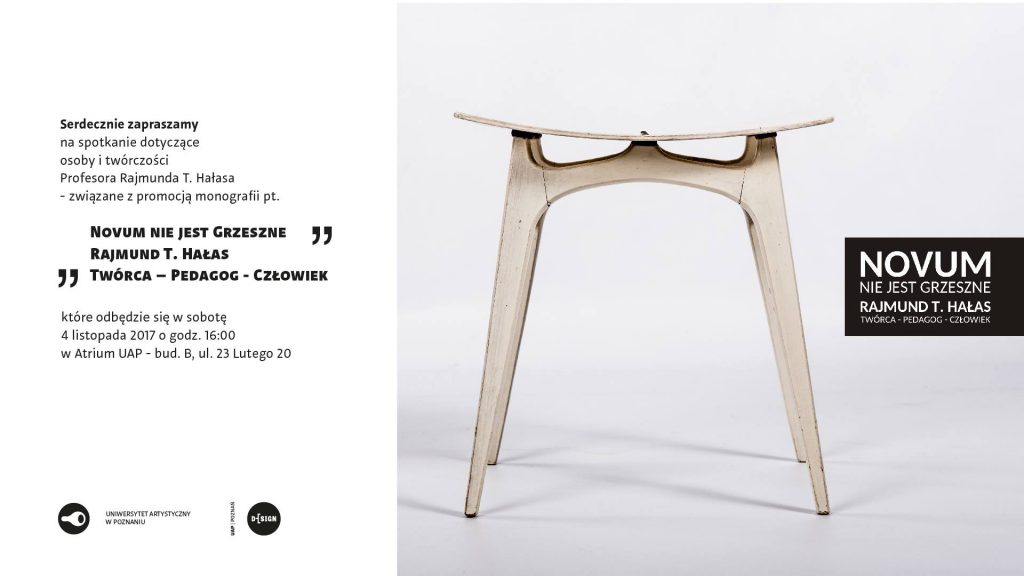
INVITATION / Premiere of the monograph devoted to Prof. RT Hałas

Premiere of the monograph devoted to Prof. RT Hałas – invitation

We cordially invite you to a meeting promoting the monograph "Novum is not sinful" (edited by Jadwiga Filipiak). The publication is devoted to the work and life of Professor Rajmund Teofil Hałas, one of the most outstanding Polish designers, founder of the Department of Industrial Design at the Poznań State Higher School of Fine Arts, whose work and legacy we systematically present to design enthusiasts at nowymodel.org. The meeting is organized by the University of Arts in Poznań.

November 4 (Saturday) 2017, 4:00 PM
Atrium UAP, building B
ul. 23 Lutego 20 (entrance also from Al. Marcinkowskiego 29)

As part of the "Icons of Polish Design" series, nowymodel.org has implemented the following furniture designed by Prof. RT Hałas:

Shelf with variable heights

The shelf was designed in 1959 and first put into production by nowymodel.org in 2013.

IMUGO stool

A stool from 1960, first put into production by nowymodel.org in 2014.

COFFEE and CIGARETTES coffee table

"I don't remember exactly when this design was conceived. We've had a prototype since the early 1960s. My husband called this little table 'COFFEE AND CIGARETTES...'" recalled Stanisława Hałasowa, showing us this marvel. It was first put into production by nowymodel.org in 2014.

RED, WHITE, BLACK chairs

Designed between 1957 and 1962, their prototypes, made in the 1960s, never entered production, but they survived in a family collection in Krajków. After more than 60 years, they were reconstructed and first put into production by nowymodel.org in 2017.

Source:

http://uap.edu.pl/2017/10/rajmund-t-halas-prezentacja-tworczosci-i-promocja-ksiazki/


Posted on

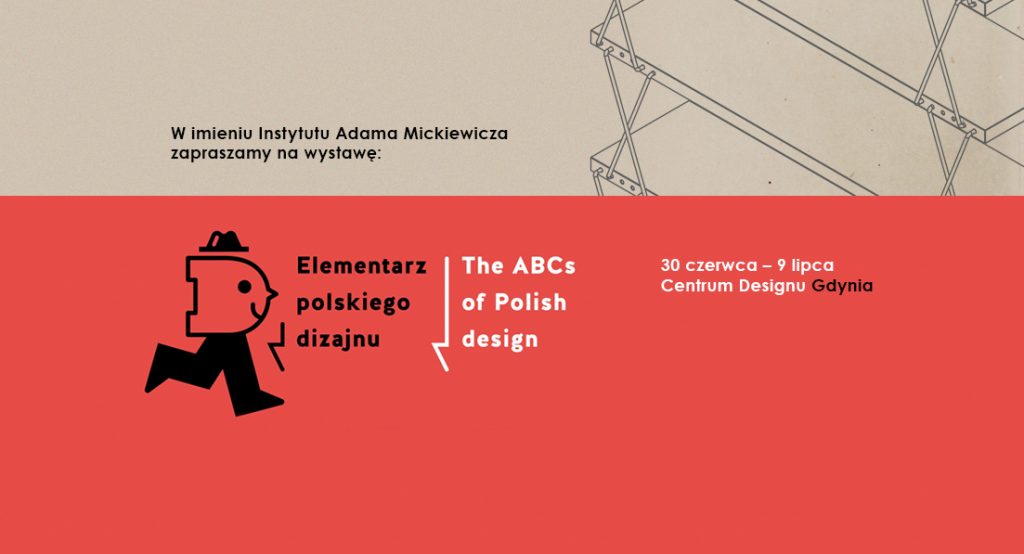
The ABCs of Polish Design exhibition


Together with Adam Mickiewicz Institute we are counting down to the start of the festival Gdynia Design Days during which the exhibition will take place The ABCs of Polish Design which will showcase the 100 most important Polish design projects of the last century, including the "Variable Height Shelf" designed by Professor Rajmund T. Hałas.
WE INVITE YOU.

The exhibition will be on view in Gdynia from June 30 to July 9, 2017. It will then move to Budapest, where it will be open to the public for a month, from September 25 to October 25, 2017.

The exhibition is organised by the Adam Mickiewicz Institute / Culture.pl
Co-organizers: Gdynia Design Days, Regional Museum in Stalowa Wola
Project supported by the Ministry of Culture and National Heritage Program Independent


„…The 100 most important Polish design projects from the last century will be exhibited in Gdynia between June 30 and July 9, 2017. The exhibition will then move to Budapest, where it will be open to visitors for a month, from September 25 to October 25, 2017.

It's not easy to showcase 100 years of Polish design by limiting yourself to just 100 objects. How do you choose the most important elements? How do you avoid the temptation to showcase only icons? How do you engage more than just experts? How do you showcase the diversity of design disciplines?

Among the 100 projects, next to furniture, glass and porcelain, i.e. items commonly associated with design, there were things such as:The most obvious: typefaces, logos, children's toys, a locomotive, a neon sign, a glider, a scooter, and even the tastiest Polish treat, Ptasie Mleczko, and the rubber ring, Ringo – a Polish sports game. Presented are both contemporary designs and those that have already earned the title of classic. Unique pieces, bordering on individual works of art; prototypes that never entered mass production; but also very popular items that Poles have used daily for the past 100 years.

This exhibition also connects the past with the present, showcasing the legacy of Polish design through the achievements of contemporary Polish graphic design. The "Primer" exhibition presents 100 works by Polish designers interpreted by twenty-five Polish illustrators – artists with very diverse backgrounds: experienced masters of the Polish School of Illustration, illustrators of the young and middle generation currently winning awards worldwide, and young artists who have just graduated. Most of the invited graphic designers illustrate children's books while also working in the broad field of visual communication. They represent a variety of styles and techniques, but all share a common talent.

The exhibition is not only 100 objects and 100 artistic interpretations of them, but also 100 stories: about designers, needs, dreams, possibilities, and limitations. It tells more than just specific projects. It also reveals the design process, how ideas are created, and ultimately, the incredible concept of design – the art form closest to humanity, one that surrounds us all, one that we interact with every day, and one that we couldn't live without, though we often don't realize it.

The chronological presentation of the projects highlights how, throughout the 100-year history of Polish design, certain materials, themes, and forms recur, constantly taking on new forms. The exhibition is aimed at a wide audience, including the youngest generation. It was created to commemorate the centenary of Poland's independence.

The exhibition is curated by Ewa Solarz. Participating illustrators include: Jacek Ambrożewski, Edgar Bąk, Maciek Blaźniak, Katarzyna Bogucka, Ada Buchholc, Iwona Chmielewska, Robert Czajka, Agata Dudek, Emilia Dziubak, Małgorzata Gurowska, Monika Hanulak, Marta Ignerska, Tymek Jezierski, Paweł Jońca, Agata Królak, Grażka Lange, Patryk Mogilnicki, Piotr Młodożeniec, Ania Niemierko, Ola Niepsuj, Marianna Oklejak, Paweł Pawlak, Dawid Ryski, Marianna Sztyma, and Ola Woldańska-Płocińska.

The exhibition is organised by the Adam Mickiewicz Institute operating under the Culture.pl brand.

Co-organizers:
Gdynia Design Days This annual festival showcases the latest trends and best practices in design. The program, packed with inspiring exhibitions, lectures, workshops, talks, and discussions, is aimed at professionals, young entrepreneurs, and enthusiasts seeking inspiration for creative endeavors and creative pastimes. For 10 days in July, Gdynia becomes the premier summer meeting place for the design industry. Gdynia is also the only design festival in Poland where prototypes with a chance of implementation are created.
http://gdyniadesigndays.eu/
Regional Museum in Stalowa Wola....”


Posted on

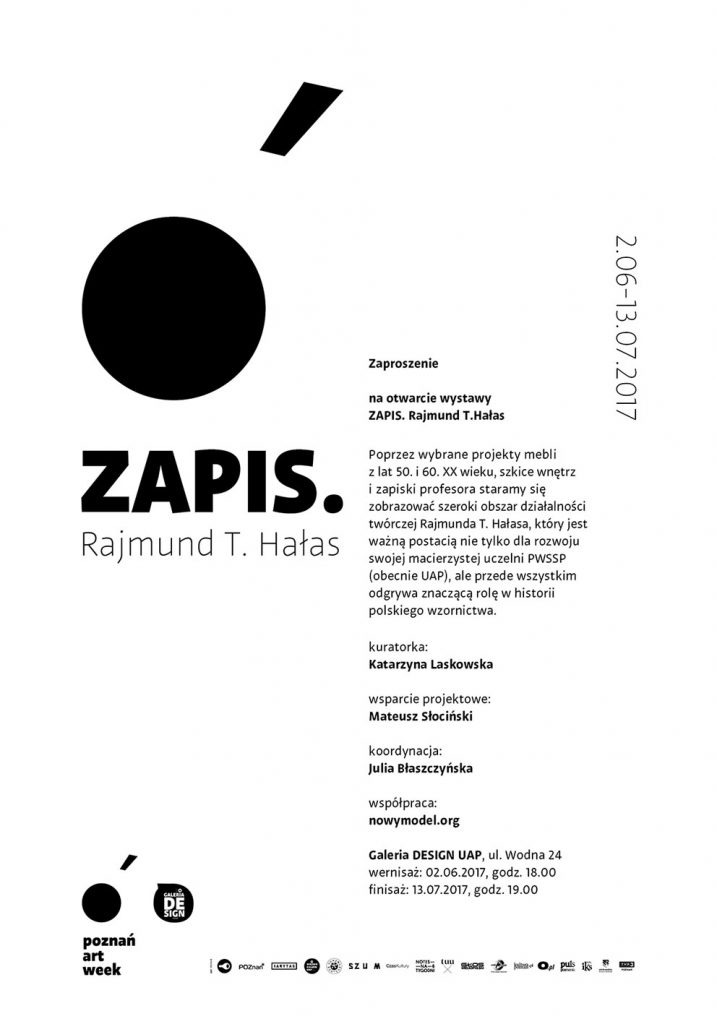
Exhibition at the Design UAP Gallery in Poznań

RECORDED. Rajmund T. Hałas

2/06/2017 – 13/07/2017
opening 2.06., 6:00 p.m.
Closing Ceremony 13/07, 7:00 p.m.
Design UAP gallery
Wodna Street 24

curator: Katarzyna Laskowska
design support: Mateusz Słociński
coordination: Julia Błaszczyńska
cooperation: nowymodel.org

„"Design, throughout its entire process, is the art of decision-making. The more extensive the designer's knowledge and the freer their way of thinking, the more accurate the decision-making will be.".

RT Hałas, "Poznań furniture school, some reflections".

RECORDED. Rajmund T. Hałas This is the first in a series of exhibitions aimed at showcasing the work of designers from Greater Poland associated with the University of Arts in Poznań. The exhibition explores the creative and teaching phenomena of Rajmund T. Hałas. The professor is an important figure not only in the development of his alma mater, the State Higher School of Fine Arts (now the University of Arts in Poznań), but above all, plays a significant role in the history of Polish design. He first learned the secrets of carpentry at his home school in Krobia.
Currently, the family furniture factory houses the Museum of Carpentry and Bishopric, run by the Krobska Region Foundation named after Professor Rajmund Teofil Hałas. While studying in Poznań, Rajmund T. Hałas was a student of Professor Jerzy Staniszkis, Professor Jan Bogusławski, Professor Jan Węcławski, and Professor Jan Cieśliński.
He has educated generations of design personalities, including his first assistant Jadwiga Filipiak, Tomasz Matuszewski, Sylwester Kluś, Jacek Patyk and Bogumiła Jung.
The next generation of designers included Bogdan Cieślak, Tomasz Wojtkowiak, Dorota Koziara, Tomasz Augustyniak, and Mikołaj Wierszyłowski. A significant event in the school's history was the establishment of the Department of Industrial Design at the State Higher School of Fine Arts in 1971 by Rajmund T. Hałas, later renamed the Department of Industrial Design.

The essence of Rajmund T. Hałas's work is the intertwining of creative fields: design, teaching, art, and the development of the design discipline. Through selected furniture designs from the 1950s and 1960s, we present mass-produced furniture – a fragment of the Type 1329 set, prototypes of seats that were never put into production, and reissues of furniture available since 2013. From the second half of the 1950s, Rajmund T. Hałas worked for the furniture industry, designing "New Furniture Designs" for the Central Centre for Furniture Development in Poznań (CORM), later OBROM. He created many designs, which the Poznań Furniture Industry Association included in its catalogs. After being presented at national fairs, the professor's designs were purchased by manufacturing plants and implemented into mass production. Some furniture designs have survived in the form of documentation, models, and prototypes. Several pieces are now part of private collections. Based on these models, or simply the designs, the company nowymodel.org developed and introduced into production three groups of furniture, starting from Shelves with variable heights in 2013, after coffee and cigarettes table and in the following years a stool IMUGO.

Professor Zdzisław Kępiński, summarizing the decade of the 1950s and 1960s, states: "the furniture trend became an exponent of the practical functions of a room, thus becoming part of architecture (...) based on the principle of modern architectural integration." He also notes that from this period onward, the concept of the so-called Poznań School of furniture design was established, and has been widely used since then (1971). Another name for the same phenomenon, in which Rajmund T. Hałas played a significant role, is the "Poznań School of Furniture.".[1]

The exhibition revisits the parallel areas of the professor's active work in developing the discipline of design. Rajmund T. Hałas was the founder of the KOŁO group, which included Czesław Kowalski, Leonard Kuczma, and Janusz Różański. In 1960, this group of designers initiated activities to develop the discipline of design and began work on organizing the Poznań Furniture Triennial. Less than twenty years later (in 1978), the Organizing Committee of the First International Furniture Triennial was established. The First International Furniture Triennial took place at the Poznań International Fair in 1980, providing a platform for intercultural exchange for designers, technologists, manufacturers, and critics. Witold Gyurkovich was the head of the First Furniture Triennial office.

Carlo Bartoli, one of the jury members of the Furniture Triennial, wrote in 1980: "Furniture and household items are full of meanings discernible through their form. They now represent the history of civilization and the techniques of the societies that produced them, and their current use reveals the evolution of customs in our society. (...) The shape of objects is like the words of a spoken language; to speak, one needs to know the rules of combining words. Similarly, to design furniture, one needs to know the rules governing form, both from the point of view of expression and technique."„[2]. Perhaps the ZAPIS Rajmund. T. Hałas exhibition will become an impulse to continue the ever-present idea of the Poznań Furniture Triennial?

[1]  Zdzisław Kępiński, 1919-1969 State Higher School of Fine Arts in Poznań, 1971.

[2]  Carlo Bartoli, Catalog of the Furniture Triennial, 1980.