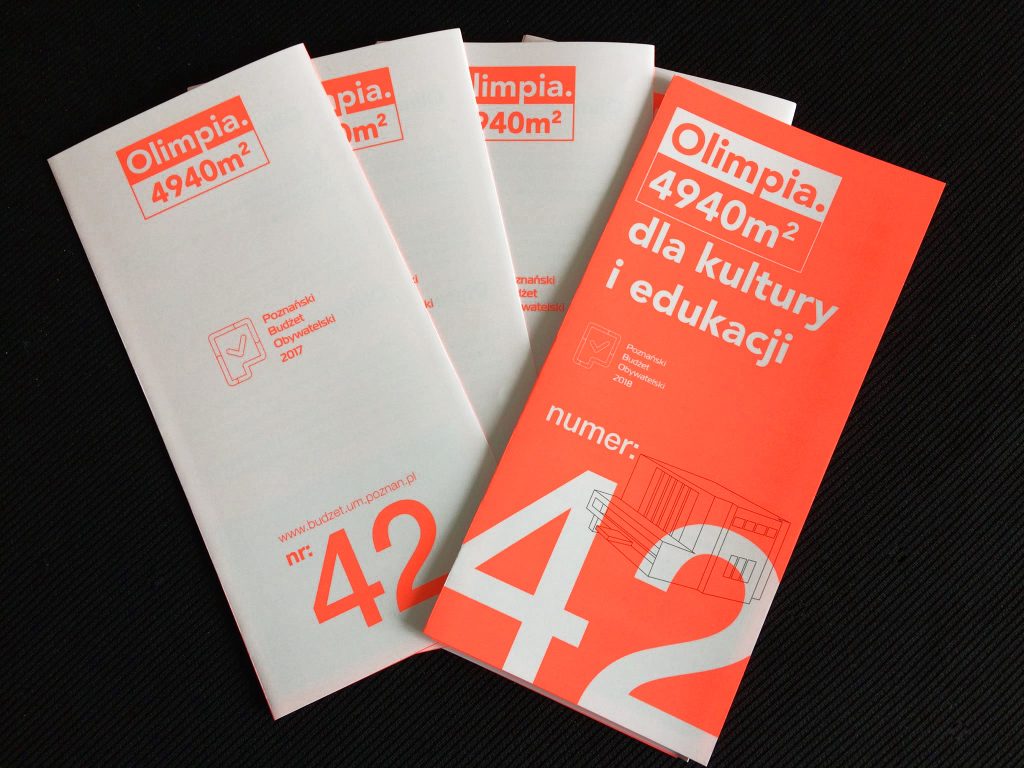
We cordially encourage all lovers of good design from Poznań to vote for Olimpia (project no. 42) in the Poznań Participatory Budget. Let's bring back Olympia, the city, its inhabitants and local artists. We need your support to ensure that Olimpia, instead of being a vacant building, becomes a thriving center of culture, art, and education. City-wide project No. 42 This is a chance to develop its potential. You can vote only for a few more days – until October 30th on the Poznań Participatory Budget website. It will only take you a few moments!
The OLIMPIA Community Cultural Center is a viable response to the growing activity of Poznań residents and the housing shortages faced by even the largest festival organizers. The building's prime location, size, and green courtyard offer the opportunity to create a year-round cultural and educational space. It can accommodate independent theaters, studios, thematic workshops, galleries, rehearsal spaces, offices of associations and aid foundations, and local senior clubs.
The OLIMPIA building, which covers 4,940 square meters, is the only cultural facility in Poznań that is four-fifths vacant. OLIMPIA requires a major renovation, for which, of course, there are no funds.
To continue waiting for a miracle is public waste.
Let's take the first step. We want to use the money for: ✔construction and commissioning of a heating system for the entire building ✔repair of the building's electrical and power installations ✔ elevator replacement
This is why: ✔ We encourage you to become interested in the idea of a Citizens' Budget. ✔We encourage you to vote for project no. 42: Olimpia. 4,940 m2 for culture and education.
Let's create a Social Place of Culture together!
The author of the project to revive Olympia is Adam Ziajski, head of the Working Stage – Center for Theatre Studies
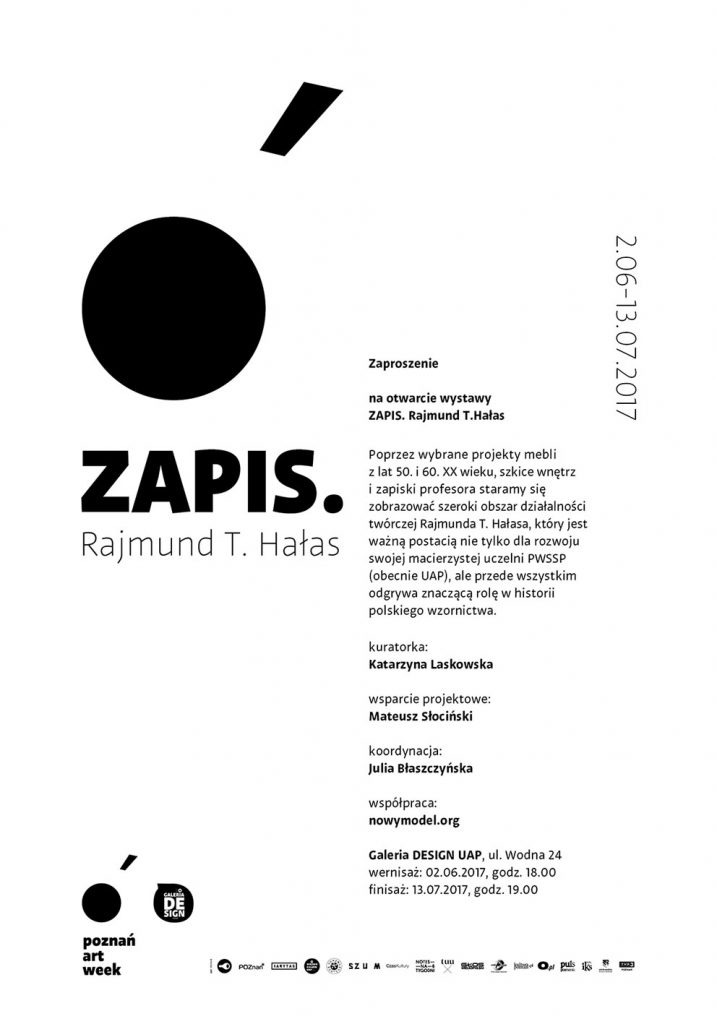
2.06.2017 – 13.07.2017 Opening day: June 2, 6:00 PM Closing day: 13/07/2019, 7:00 PM Design UAP Gallery Wodna Street 24 Curator: Katarzyna Laskowska Planning Support: Mateusz Słociński Coordinator: Julia Błaszczyńska In collaboration with:nowymodel.org
“Designing, in whole it's process is an art of decision-making. The wider the knowledge of the designer, and the freer the way they think, the more accurate a decision will be made.”
RT Hałas, "Poznań furniture school, some reflections".
RT Hałas, "Poznań furniture school, some reflections".
RECORD. Rajmund T. Hałas is the first of a series of exhibitions presenting the output of Wielkopolska's designers associated with the University of Arts in Poznań. The exhibition shines a light on the creative and didactic phenomenon of Rajmund T. Hałas. The professor is important not only for his alma mater, the PWSSP(Currently UAP), but above all else, for the history of Polish design. He learned the ropes of the art of carpentry in his family town, Krobia.
Currently, his family factory hosts the Museum of Woodwork and Local Folklore, led by Rajmund Teofil Hałas' Krob Land Foundation. During his academic years in Poznań, Rajmund T. Hałas studied under Prof. Jerzy Staniszkis, Prof. Jan Bogusławski, Prof. Jan Węcławski, and Prof. Jan Cieśliński.
The professor has shaped generations of designers, including his first assistant Jadwiga Filipiak, Tomasz Matuszewski, Sylwester Kluś, Jacek Patyk, and Bogumiła Jung. The generation of designers that followed included, among others, Bogdan Cieślak, Tomasz Wojtkowiak, Dorota Koziara, Tomasz Augustyniak, and Mikołaj Wierszyłowski. One of the more important milestones in the history of the university was 1971, when Rajmund T. Hałas created the Department of Industrial Form Design at PWSSP, later transforming it into the Department of Industrial Design.
The essence of Rajmund T. Hałas' work is the way his creative activities are intertwined with one another: design, didactics, art, and the development of the area of his expertise. Through a selection of furniture designs from the 50's and 60's we're showing both the mass-produced ones, like part of the Type 1329 set, prototypes of the seats that haven't made it to production, and the 2013 reeditions of his furniture. Since the late 50's Rajmund T. Hałas has worked for the furniture industry, designing ’New Furniture Projects’ for the CORM(Later OBROM). He's created numerous designs that the Union of Furniture Industry in Poznań has put in their catalogs. After being presented at domestic fairs, the professor's designs have been bought and introduced to mass production. Some of the designs had survived in records, mockups, and prototypes; a few of them ended up in private collections. Based on said mockups, or just the schematics, nowymodel.org has developed and began the production of three groups of furniture, from the Adjustable Height Bookcase in 2013, through the Coffee and Cigarettes coffee table, to the IMUGO stool.
Professor Zdzisław Kępiński, in his summary of the 50's says: ’furniture, as a field of study, was becoming an indicator of the practical functions of a room, thus becoming part of architecture (…) operating as modern architectural integration.“ He also remarks that it is since the 50's that the term of so-called Poznań School in furniture design has been coined – a term that was still widely used as of 1971. An another name for this phenomenon, in which Rajmund T. Hałas has played a key role, is the Poznań School of Furniture. [1]
The exhibitions brings back the parallel areas of the professor's active work towards the development of design. Rajmund T. Hałas has founded KOŁO, a group consisting of Czesław Kowalski, Leonard Kuczma, and Janusz Różański. In 1960, said group of designers had initiated numerous actions leading to the advancement of design as a whole. They've begun working to organize a Furniture Triennial in Poznań. Less than 20 years later (1978), an Organizational Committee of the 1st International Furniture Triennial has been brought to life. The 1980 Poznań International Fair has hosted the 1st International Furniture Triennale, a platform for intercultural exchange for designers, technologists, producers, and critics, with Witold Gyurkovich as the head of its office.
In 1980, Carlo Bartoli, one of the Triennial's jury wrote: Furniture and household items are full of meanings perceivable through their form. Currently they are a reflection of the history of civilization and techniques of the societies that manufactured them, and the way they're used shows the evolution of customs in our society. (…) The shape of an item is like a word in spoken language – one needs to know the rules of word linking in order to speak. Analogically, to design furniture, the knowledge of the rules of form is neccessary, both from the expression's and the technique's point of view.”[2]. Perhaps the ZAPIS Rajmund T. Hałas will become a spark to reignite the – still important – idea of the Furniture Triennale in Poznań?
[1] Zdzisław Kępiński, 1919-1969 PWSSP in Poznań, 1971.
[2] Carlo Bartoli, Furniture Triennial Catalogue, 1980.
curator: Katarzyna Laskowska design support: Mateusz Słociński coordination: Julia Błaszczyńska cooperation: nowymodel.org
„"Design, throughout its entire process, is the art of decision-making. The more extensive the designer's knowledge and the freer their way of thinking, the more accurate the decision-making will be.".
RT Hałas, "Poznań furniture school, some reflections".
RECORDED. Rajmund T. Hałas This is the first in a series of exhibitions aimed at showcasing the work of designers from Greater Poland associated with the University of Arts in Poznań. The exhibition explores the creative and teaching phenomena of Rajmund T. Hałas. The professor is an important figure not only in the development of his alma mater, the State Higher School of Fine Arts (now the University of Arts in Poznań), but above all, plays a significant role in the history of Polish design. He first learned the secrets of carpentry at his home school in Krobia. Currently, the family furniture factory houses the Museum of Carpentry and Bishopric, run by the Krobska Region Foundation named after Professor Rajmund Teofil Hałas. While studying in Poznań, Rajmund T. Hałas was a student of Professor Jerzy Staniszkis, Professor Jan Bogusławski, Professor Jan Węcławski, and Professor Jan Cieśliński. He has educated generations of design personalities, including his first assistant Jadwiga Filipiak, Tomasz Matuszewski, Sylwester Kluś, Jacek Patyk and Bogumiła Jung. The next generation of designers included Bogdan Cieślak, Tomasz Wojtkowiak, Dorota Koziara, Tomasz Augustyniak, and Mikołaj Wierszyłowski. A significant event in the school's history was the establishment of the Department of Industrial Design at the State Higher School of Fine Arts in 1971 by Rajmund T. Hałas, later renamed the Department of Industrial Design.
The essence of Rajmund T. Hałas's work is the intertwining of creative fields: design, teaching, art, and the development of the design discipline. Through selected furniture designs from the 1950s and 1960s, we present mass-produced furniture – a fragment of the Type 1329 set, prototypes of seats that were never put into production, and reissues of furniture available since 2013. From the second half of the 1950s, Rajmund T. Hałas worked for the furniture industry, designing "New Furniture Designs" for the Central Centre for Furniture Development in Poznań (CORM), later OBROM. He created many designs, which the Poznań Furniture Industry Association included in its catalogs. After being presented at national fairs, the professor's designs were purchased by manufacturing plants and implemented into mass production. Some furniture designs have survived in the form of documentation, models, and prototypes. Several pieces are now part of private collections. Based on these models, or simply the designs, the company nowymodel.org developed and introduced into production three groups of furniture, starting from Shelves with variable heights in 2013, after coffee and cigarettes table and in the following years a stool IMUGO.
Professor Zdzisław Kępiński, summarizing the decade of the 1950s and 1960s, states: "the furniture trend became an exponent of the practical functions of a room, thus becoming part of architecture (...) based on the principle of modern architectural integration." He also notes that from this period onward, the concept of the so-called Poznań School of furniture design was established, and has been widely used since then (1971). Another name for the same phenomenon, in which Rajmund T. Hałas played a significant role, is the "Poznań School of Furniture.".[1]
The exhibition revisits the parallel areas of the professor's active work in developing the discipline of design. Rajmund T. Hałas was the founder of the KOŁO group, which included Czesław Kowalski, Leonard Kuczma, and Janusz Różański. In 1960, this group of designers initiated activities to develop the discipline of design and began work on organizing the Poznań Furniture Triennial. Less than twenty years later (in 1978), the Organizing Committee of the First International Furniture Triennial was established. The First International Furniture Triennial took place at the Poznań International Fair in 1980, providing a platform for intercultural exchange for designers, technologists, manufacturers, and critics. Witold Gyurkovich was the head of the First Furniture Triennial office.
Carlo Bartoli, one of the jury members of the Furniture Triennial, wrote in 1980: "Furniture and household items are full of meanings discernible through their form. They now represent the history of civilization and the techniques of the societies that produced them, and their current use reveals the evolution of customs in our society. (...) The shape of objects is like the words of a spoken language; to speak, one needs to know the rules of combining words. Similarly, to design furniture, one needs to know the rules governing form, both from the point of view of expression and technique."„[2]. Perhaps the ZAPIS Rajmund. T. Hałas exhibition will become an impulse to continue the ever-present idea of the Poznań Furniture Triennial?
[1] Zdzisław Kępiński, 1919-1969 State Higher School of Fine Arts in Poznań, 1971.
[2] Carlo Bartoli, Catalog of the Furniture Triennial, 1980.
Photo report from design workshops for children, organized by nowymodel.org in Stary Browar in Poznań.
The first in a series of workshops for children took place on January 28th and 29th. They will be led by Cyryl Zakrzewski, a participant in numerous exhibitions in Poland and abroad (Japan, Italy, Slovenia, Austria), author of permanent installations in public spaces in cities including Poznań and Tokyo, and a graduate of the Faculty of Sculpture and Spatial Actions at the University of Arts in Poznań.
Workshop participants created lamps from recycled paper.
When: January 28 (11:00 a.m. - 1:00 p.m. and 2:00 - 4:00 p.m.), January 29 (11:00 a.m. - 1:00 p.m.) Location: Atrium +1 For whom: children from 5 years old, work in groups of up to 15 people.
We would like to thank Stary Browar for providing photos from the workshops.
You can see the designs of the Masters (Rajmund Teofil Hałas and Bogusława and Czesław Kowalski), as well as the younger generation of designers collaborating with our foundation, and fall in love with them at first sight, or test them, get used to them, like them and… order them :) Where: Stary Browar / Półwiejska Street 42 / Poznań / Atrium +1 (balcony)
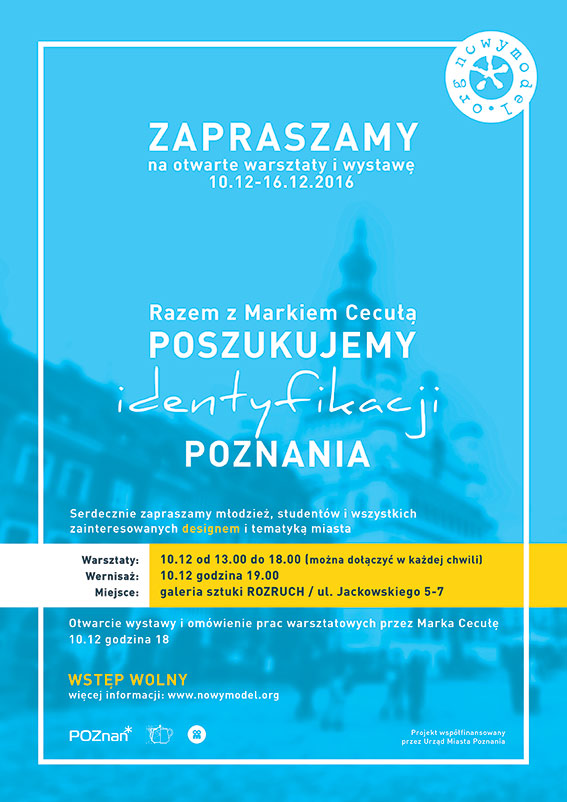
Open WORKSHOPS: „"We are looking for the identity of Poznań"” December 10, from 1 p.m. to 6 p.m. You can join the workshops at any time
OPENING and DISCUSSION of the design works by Marek Cecuła: December 10, 7 p.m.
The exhibition can be viewed from December 10 to 16, 2016, from 3 to 6 p.m.
Project co-financed by the City of Poznań.
EXHIBITION: "Together with Marek Cecuła, we are looking for the identity of Poznań"„
We cordially invite you to an exhibition of modern porcelain designed by Marek Cecuła and his design studio Modus Design, presenting porcelain objects made with Poznań and its promotion through design in mind.
The exhibition will also feature furniture and other functional objects designed by artists collaborating with the Nowymodel Foundation. These include works by Cyryl Zakrzewski, Ronen Kadushin, Karol Starczewski, and Michał Dumin. Classics of Polish design by designers from Greater Poland, brought back to life by the nowymodel.org foundation, will also be on display: a variable-height bookcase and a table designed by Professor Rajmund Teofil Hałas, and the "Kowalski Chair" designed by Bogusława and Czesław Kowalski.
Poznań City Hall announced a competition in the fall for the logo for the Free City of Poznań slogan, thus initiating a broader discussion about the image and visual identification of our city. What can we replace the "city of know-how" and the infamous star? What could Poznań residents identify with? How should we promote our city today?
Some of the specific motifs associated with the region in the minds of Poles are Poznań potato dumplings, koziołki (goats) or St. Martin's croissants... On the other hand, Poznań is a city that can boast a long tradition of design, crafts and, in general, products of material culture.
Following this lead, thanks to the collaboration between the nowymodel.org foundation, Modus Design, and the porcelain factory in Ćmielów, we managed to persuade the charismatic and probably the most recognizable Polish designer in the world – Marek Cecuła – to design unique porcelain objects referring to the symbolism and tradition of Poznań.
What will these facilities be like? Come and see for yourself.
WORKSHOPS: Participants will be able to tackle design tasks and issues related to the city and its problems, particularly those related to visual identification, with expert assistance from workshop leaders from the nowymodel.org Foundation. The works will be hung on strings – in a workshop format called "design washing" – and will become an interesting, substantive and spatial object. The workshop format is inspired by the plein-air workshops led by Professor Rajmund Teofil Hałas, one of the masters of Greater Poland design. The professor encouraged his students to think creatively in every possible way. One of these was this "washing," or attempting to look at design with a completely new perspective: as if it had become very dirty from the stains of routine, as if it had become stiff with dust, as if it had turned gray and faded…
The entire process will culminate in design consultations – a discussion of the work – conducted by renowned designers, including Marek Cecuła, Edyta Cieloch, Cyryl Zakrzewski, and a discussion.
MAREK CECUŁA: A world-renowned artist, ceramist, educator, and curator. One of the most charismatic figures in Polish design, a charming erudite with Renaissance horizons. A designer of functional ceramics, he also treats it as a medium for expressing important artistic messages. In his work, the boundaries between design, craft, and sculpture are virtually nonexistent. Meeting Marek Cecuła is an intellectual feast: his extensive experience, travels, the passion with which he approaches his work and art, his curiosity about the world, and the joy of constantly learning about it make the conversation endless. Whether the artist is discussing a new project, a material he has suddenly discovered that inspires him, contemporary theater, early music, or oriental cuisine—everything becomes a fascinating adventure. He was born on April 23, 1944, in Częstochowa and lived in Kielce. He emigrated to Israel at the age of 16. Then came Brazil, and from 1976, New York. There, he founded the Modus Design studio and the Contemporary Porcelain gallery. He was Dean of the Ceramics Department at Parsons School of Design in New York (1985-2004) and a guest professor at the National Academy of the Arts in Bergen (2004-2010). In the late 1990s, he moved his Modus Design studio to Poland. In 2012, he opened the Design Centrum Kielce, and a year later, the Ćmielów Design Studio, of which he is the artistic director. Everything he knows about ceramics (and he knows a lot!) he learned "on the road," gaining experience on various continents.






 EN
EN  PL
PL