Our bookcase designed by Prof. Rajmund Teofil Hałas – awarded in the Good Design 2016 competition – in the post exhibition catalog issued by the Institute of Industrial Design.


Our bookcase designed by Prof. Rajmund Teofil Hałas – awarded in the Good Design 2016 competition – in the post exhibition catalog issued by the Institute of Industrial Design.


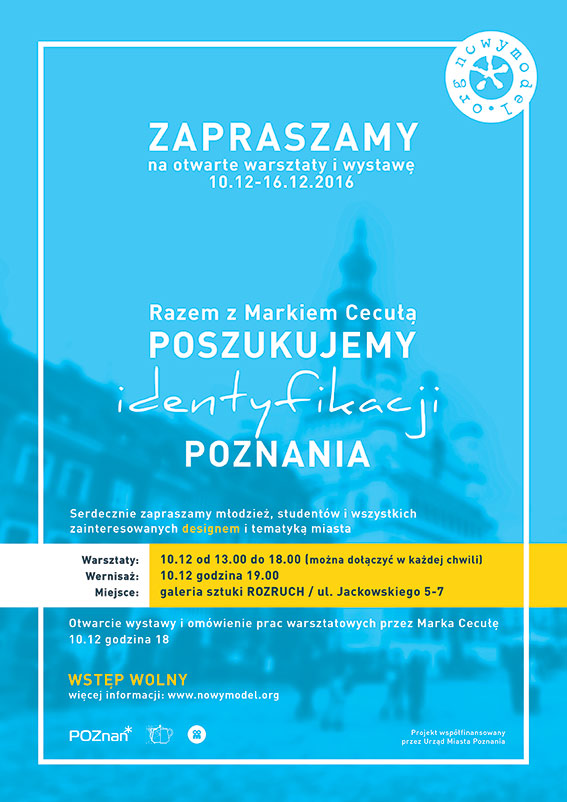
ROZRUCH Art Gallery, Jackowskiego Street 5-7
Open WORKSHOPS:
„"We are looking for the identity of Poznań"”
December 10, from 1 p.m. to 6 p.m.
You can join the workshops at any time
OPENING and DISCUSSION of the design works by Marek Cecuła:
December 10, 7 p.m.
The exhibition can be viewed from December 10 to 16, 2016, from 3 to 6 p.m.
Project co-financed by the City of Poznań.
EXHIBITION: "Together with Marek Cecuła, we are looking for the identity of Poznań"„
We cordially invite you to an exhibition of modern porcelain designed by Marek Cecuła and his design studio Modus Design, presenting porcelain objects made with Poznań and its promotion through design in mind.
The exhibition will also feature furniture and other functional objects designed by artists collaborating with the Nowymodel Foundation. These include works by Cyryl Zakrzewski, Ronen Kadushin, Karol Starczewski, and Michał Dumin. Classics of Polish design by designers from Greater Poland, brought back to life by the nowymodel.org foundation, will also be on display: a variable-height bookcase and a table designed by Professor Rajmund Teofil Hałas, and the "Kowalski Chair" designed by Bogusława and Czesław Kowalski.
Poznań City Hall announced a competition in the fall for the logo for the Free City of Poznań slogan, thus initiating a broader discussion about the image and visual identification of our city.
What can we replace the "city of know-how" and the infamous star? What could Poznań residents identify with? How should we promote our city today?
Some of the specific motifs associated with the region in the minds of Poles are Poznań potato dumplings, koziołki (goats) or St. Martin's croissants... On the other hand, Poznań is a city that can boast a long tradition of design, crafts and, in general, products of material culture.
Following this lead, thanks to the collaboration between the nowymodel.org foundation, Modus Design, and the porcelain factory in Ćmielów, we managed to persuade the charismatic and probably the most recognizable Polish designer in the world – Marek Cecuła – to design unique porcelain objects referring to the symbolism and tradition of Poznań.
What will these facilities be like? Come and see for yourself.
WORKSHOPS:
Participants will be able to tackle design tasks and issues related to the city and its problems, particularly those related to visual identification, with expert assistance from workshop leaders from the nowymodel.org Foundation. The works will be hung on strings – in a workshop format called "design washing" – and will become an interesting, substantive and spatial object. The workshop format is inspired by the plein-air workshops led by Professor Rajmund Teofil Hałas, one of the masters of Greater Poland design. The professor encouraged his students to think creatively in every possible way. One of these was this "washing," or attempting to look at design with a completely new perspective: as if it had become very dirty from the stains of routine, as if it had become stiff with dust, as if it had turned gray and faded…
The entire process will culminate in design consultations – a discussion of the work – conducted by renowned designers, including Marek Cecuła, Edyta Cieloch, Cyryl Zakrzewski, and a discussion.
MAREK CECUŁA:
A world-renowned artist, ceramist, educator, and curator. One of the most charismatic figures in Polish design, a charming erudite with Renaissance horizons. A designer of functional ceramics, he also treats it as a medium for expressing important artistic messages. In his work, the boundaries between design, craft, and sculpture are virtually nonexistent. Meeting Marek Cecuła is an intellectual feast: his extensive experience, travels, the passion with which he approaches his work and art, his curiosity about the world, and the joy of constantly learning about it make the conversation endless. Whether the artist is discussing a new project, a material he has suddenly discovered that inspires him, contemporary theater, early music, or oriental cuisine—everything becomes a fascinating adventure. He was born on April 23, 1944, in Częstochowa and lived in Kielce. He emigrated to Israel at the age of 16. Then came Brazil, and from 1976, New York. There, he founded the Modus Design studio and the Contemporary Porcelain gallery. He was Dean of the Ceramics Department at Parsons School of Design in New York (1985-2004) and a guest professor at the National Academy of the Arts in Bergen (2004-2010). In the late 1990s, he moved his Modus Design studio to Poland. In 2012, he opened the Design Centrum Kielce, and a year later, the Ćmielów Design Studio, of which he is the artistic director. Everything he knows about ceramics (and he knows a lot!) he learned "on the road," gaining experience on various continents.
 Product from the "Icons of Polish Design" series.
A shelf with variable heights – designed in 1959 by Professor Rajmund Teofil Hałas, the late master of Polish design (artist, architect and furniture designer) was nominated by experts to participate in the competition for the best designed products and services on the Polish market Dobry Wzór 2016. The shelf was put into production by nowymodel.org 3 years ago.


Product from the "Icons of Polish Design" series.
Our collection of furniture designed by Professor Rajmund Teofil Hałas has expanded to include the IMUGO stool. It owes its name to its mature and refined form, yet at the same time as light as an insect's wings, subtle, and graceful. Working on it was a pleasure. Thank you, Master!
IMUGO stools vary in frame and seat colors. The frame is available in two colors: white and natural beechwood. The seats will be available in natural veneer, white, and celadon.
Stools Covered with natural chestnut veneer, they vary in shade and grain. Wood is beautiful because it is variable.
nowymodel.org is the first to share the designs.
Material: solid beech wood, seat – plywood
Color: frame – painted or natural beech color,
seat – painted or veneered plywood (walnut)
Dimensions: 44 x 39 x 28 cm
Libra: 1.8 kg


An inconspicuous item that few people notice – but in this case, it's hard to ignore. The TREEE hanger
A simple yet intriguing design for this plywood coat rack. Its organic, undulating lines, reminiscent of trees and antlers, naturally combine functionality and aesthetics.
When not in use, it serves a decorative purpose. It can be displayed as a theatrical decoration or hidden under clothing. Its orderly asymmetry will enliven a traditionally decorated room without disrupting its harmony, while also providing ample scope for those who enjoy experimenting.
Designed by Mihau Dumin / Photos: Piotr Gajewski


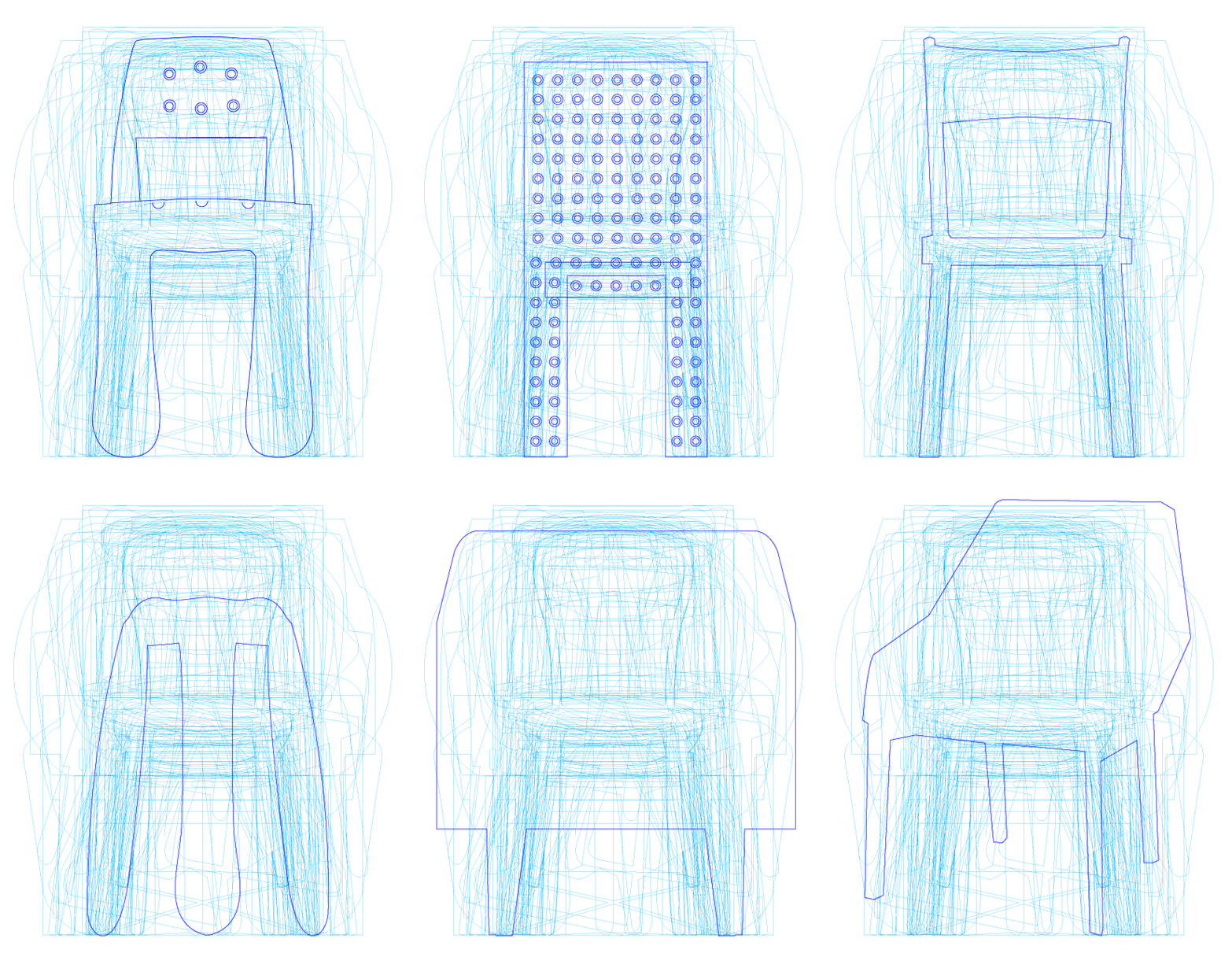
We invite you to an exhibition celebrating the opening of the "BARBARA" center – the information point for the European Capital of Culture Wrocław 2016! The "SIT DOWN IN POLISH" project aims to bring together the best examples of Polish design. All objects were designed by Polish designers and produced by Polish companies between 1941 and 2014.
The exhibition will be held from June 12th to September 3rd, 2015, at "Bar Barbara" in Wrocław. Its curator is Oskar Zięta.
 EN
EN  PL
PL